Metatronium · Scale Study
The Periscope
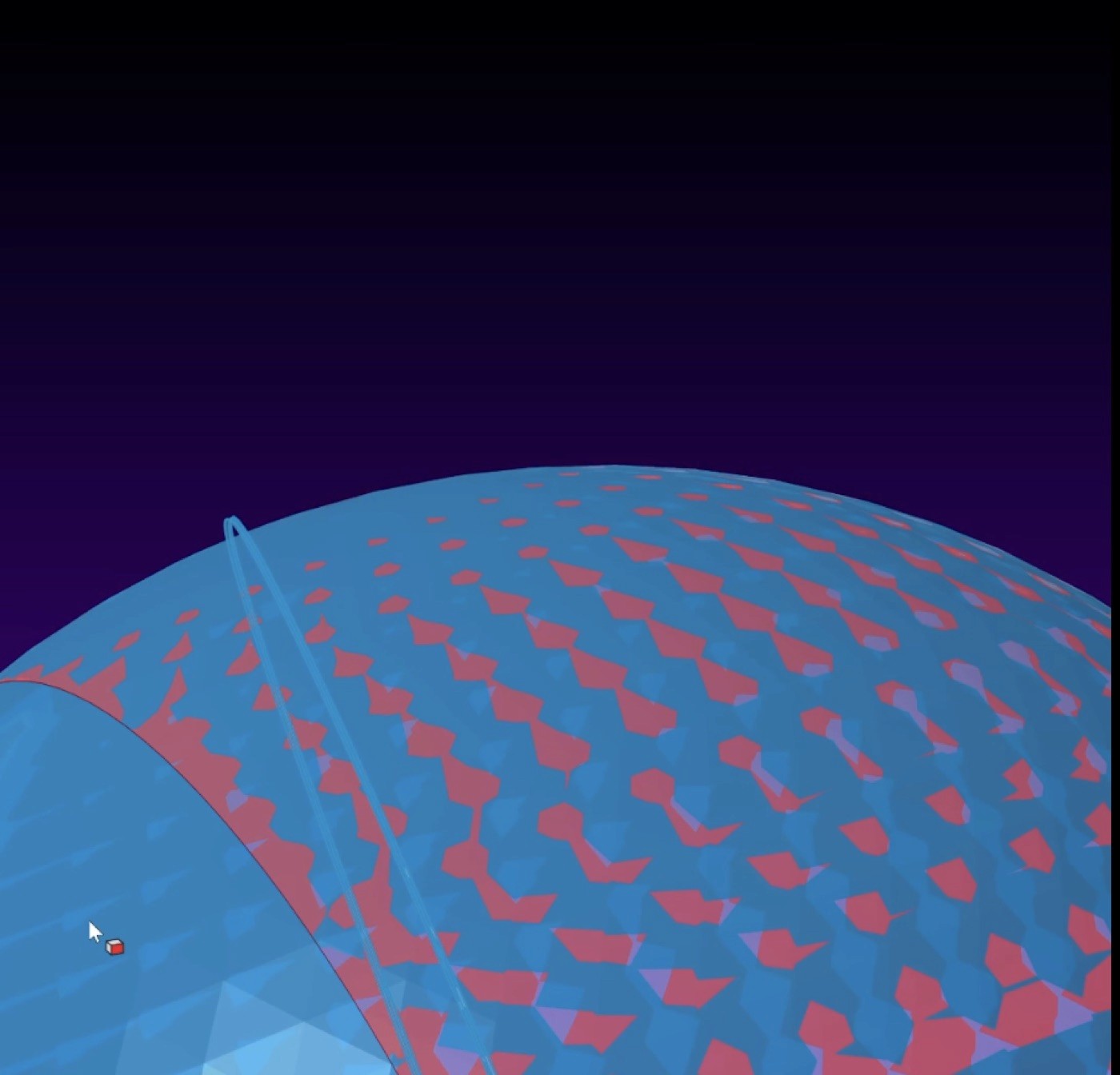
A single band, 42 kilometres wide and 21 kilometres deep, wrapped once around the equator. From the ground it isn’t a star or a satellite. It’s a V-shaped silhouette roughly forty Suns across, sliding overhead.

The cross-section
The habitat is a triangle in section: 42 kilometres across the top, tapering to a keel 21 kilometres below. Both flanks run at 45°, which makes each side face 29.6985 kilometres of continuous slant, the number that sets everything else.
- Top width
- 42 km
- Interior height
- 21 km
- Side face, bottom to top
- 29.6985 km
- Flank angle
- 45°
- Level spacing
- 150 m
- Levels
- 140
- Circumference
- 40,075,027 m
- Total floor area
- ≈ 120,520,027 km²≈ 80% of Earth’s land area
Floors are stacked every 150 metres from the keel to the top deck. Because the section is a triangle, each floor is wider than the one beneath it. The bottom levels are slivers, the top deck is the full 42 km. Summed across 140 levels and 40,075 kilometres of circumference, the interior holds roughly four fifths of Earth’s dry land.
What it looks like from below
Put the underside at 107 kilometres, just above the Kármán line. A ground observer watching it pass overhead is looking at 42 kilometres of structure at that range.
2 × arctan(21 / 107)
Twenty-two degrees is about two fists held at arm’s length. Laid across the sky as a band running horizon to horizon, that sweeps roughly 3,970 square degrees of the visible hemisphere, around eighteen thousand times the area of the Sun’s disc. The 45° flanks catch light on one side and fall to shadow on the other, so what actually crosses overhead reads as a split, V-shaped periscope: two long bright edges with a dark spine between them.

Ten metres of slack
Earth’s equatorial circumference is 40,075,017 metres. The ring is drawn at 40,075,027 — ten metres longer. That difference sounds like nothing, and as a circumference it nearly is. As a diameter it is 10 / π = 3.183 metres — the whole band standing a metre and a half clear of the reference sphere, all the way round.
A useful reminder of what the ÷π conversion does to intuition: a ten-metre error in a forty-thousand-kilometre measurement is a three-metre gap you could walk through.

“We start mining asteroids, we’re gonna have to build this thing just for bragging rights.”
— @glitchairman