August 1, 2026
Concept
Spin Population Architecture — Moon Base Alpha
A concept for a lunar crater habitat made of independently rotating concentric rings, designed to sustain Earth-normal 1 g environments for long-term biological living.
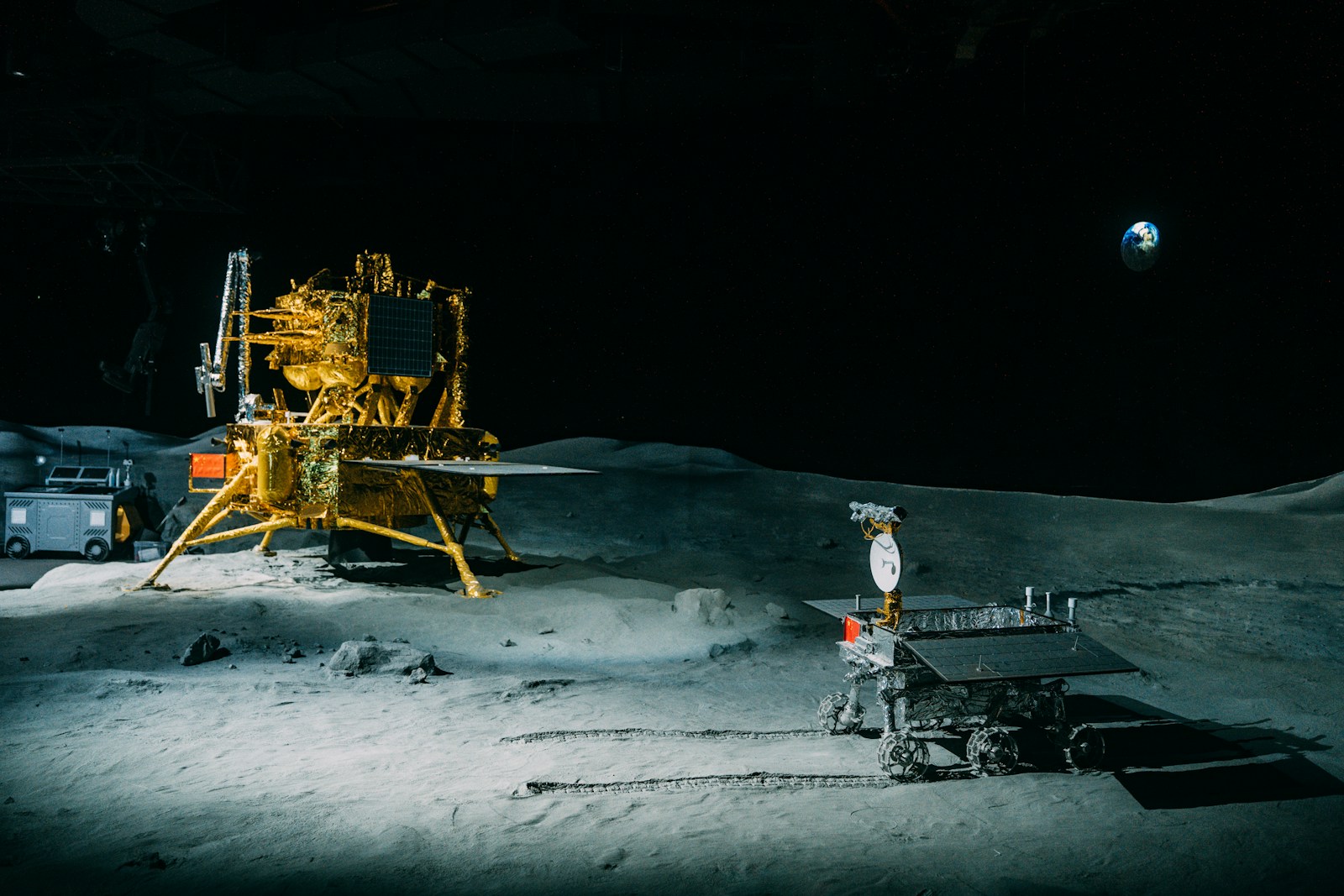
Lunar Concentric Ring Habitat System for Sustained 1 g Biological Environments. Preliminary Concept Report · August 2026 · after John (@glitchairman).
Executive Summary
A modular system of independently rotating concentric rings constructed inside a pre-existing lunar crater can provide sustained Earth-normal gravity (1 g) for long-term biological sustainability. The innermost ring operates at a maximum of 1 RPM and measures approximately 1.76 km in diameter. Successive outer rings spin more slowly while maintaining 1 g, with each ring’s radial width limited so that its vertical rise never exceeds one-fifth of its own diameter.
Motivation
Prolonged exposure to lunar gravity (≈1/6 g) produces well-documented adverse effects on human physiology, including bone density loss, muscle atrophy, and cardiovascular deconditioning. A practical method of generating sustained 1 g environments on the lunar surface is a foundational requirement for permanent settlement and closed-loop biological systems.
Core Concept
Discrete annular rings rotate about a common vertical axis inside a large lunar crater, each driven independently. Lunar gravity acts downward; centrifugal acceleration acts radially outward. The resultant effective gravity vector has magnitude 1 g and is oriented nearly horizontally, requiring the local floor of each ring to be banked at approximately 80.5° from horizontal. Because the rings are independent, spin rate can be matched to radius so every long-duration habitat zone experiences the same 1 g target — outer rings turn more slowly, and the innermost ring is limited to 1 RPM for comfort and mechanical practicality.
Key Design Parameters
Target effective gravity: 1.0 g (9.81 m/s²) for all primary biological zones.
Required centrifugal acceleration: ≈9.67 m/s².
Banking angle for 1 g rings: ≈80.5° from horizontal.
Maximum rotational speed: 1 RPM (innermost ring).
Vertical-height rule: no ring may rise more than 1/5 of its own diameter, limiting radial width to ≈6.7% of its radius.
Innermost Ring and Scaling of Outer Rings
At the 1 RPM limit the radius required for 1 g is ≈880 m, giving a diameter of ≈1.76 km, a maximum radial width of ≈59 m, and a maximum vertical rise of ≈352 m. Larger rings require lower rotational speeds to maintain the same 1 g: a 10 km ring spins at ≈0.42 RPM with ≈336 m of rise; a 20 km ring at ≈0.30 RPM with ≈672 m of rise; a 40 km ring at ≈0.21 RPM with ≈1.34 km of rise; and a 60 km ring at ≈0.17 RPM with ≈2.0 km of rise. All rings share the same banking angle — the height rule simply permits proportionally wider living bands at larger radii.
Example Capacity
Inside a Copernicus- or Tycho-class crater (≈85–95 km diameter) the radial distance from the 1.76 km core outward allows 12–20 distinct 1 g rings while respecting the height constraint and leaving space for structural buffers and access. A Clavius-scale crater (≈231 km) could accommodate substantially more.
Construction Approach
Select a suitable large crater with a workable floor.
Prepare a fixed, paved foundation system (regolith-derived materials).
Install and commission the central 1.76 km / 1 RPM ring first.
Add successive outer rings outward, each on its own concentric track and driven at the speed required for 1 g.
Provide velocity-matching transfer systems (elevators, ramps, or vehicles) between rings.
Advantages and Challenges
Advantages: sustained 1 g without continuous high-speed rotation of an entire massive structure, incremental construction and expansion, the ability to locate specialized zones on different rings, and use of existing crater topography for structural support and radiation shielding. Challenges: steep banking angles demand careful design of floors and circulation, independent drive systems and power distribution for multiple rings, more noticeable Coriolis effects on faster inner rings, and significant civil-engineering effort to manage dust and thermal extremes.
Status and Next Steps
The kinematic and geometric framework is now defined: 1 g baseline, 1 RPM inner limit, fixed banking angle, and a clear height-to-diameter rule that sizes every ring. Immediate follow-on work includes selecting a specific host crater and detailed ring schedule, first-order structural mass and power estimates, conceptual design of the ring-to-foundation interface and inter-ring transfer systems, and human-factors evaluation of daily living on an 80.5° banked surface under 1 g. The concept is internally consistent and scalable, offering a realistic pathway to Earth-normal gravity environments on the lunar surface using discrete, purpose-built rotating rings rather than a single monolithic rotating structure.